3 Reality Checks for Tracking Your Google Maps Rankings Across Different Zip Codes
You’ve done the work. You’ve claimed your listing, uploaded high-resolution photos of your latest HVAC install or roofing project, and you’ve nagged your best customers for five-star reviews. You sit down at your office desk, type your primary service into Google, and there you are – Number 1 in the local map pack. You feel invincible. Then, you head out for lunch three miles down the road, check again, and your business is nowhere to be found. It’s as if you’ve hit an invisible wall.
As a Google Business Profile Product Expert who has audited thousands of listings, I’m here to tell you: that wall is real. It’s the “proximity filter,” and it is the single biggest source of frustration for local business owners today. If you want to rank google business profile listings effectively in 2026, you have to stop thinking about your city as a single entity and start thinking about it as a complex web of hyper-local data points. Effective google business profile seo isn’t about being “number one in Chicago”; it’s about dominating the specific coordinates where your customers actually live and work.
The “5-mile radius test” is the first reality check every contractor and small business owner needs to perform. In 2026, “near me” searches have evolved. They are no longer just about matching a keyword to a city name; they are about precise spatial data. Google’s algorithm is now sophisticated enough to know that a user on the north side of a zip code has different intent and proximity needs than a user on the south side. If your tracking strategy doesn’t account for this, you’re flying blind. In this guide, I’m going to provide three “brutally honest” reality checks that will change how you view your local rankings forever.
Internal Link: Why Your Map Ranking Stalls Just Five Miles From Your Office
Reality Check #1: The “Centroid” Trap and the Fallacy of City-Wide Tracking
Most local seo tools on the market are lying to you. Or, at the very least, they are giving you a dangerously oversimplified version of the truth. For years, the standard way to track rankings was to set a “location” in your software – say, “Dallas, TX” – and see where you landed. This relies on what we call “centroid logic.”
Google defines every city, town, and zip code by a single geographic center – the centroid. When a legacy google maps rank tracker pings Google for a keyword like “Plumber in Chicago,” it often mimics a search happening exactly at that central point. If your business is located two blocks from the Chicago centroid, you’ll look like a hero in your reports. But for the plumber located in Naperville or the contractor in Lincoln Park, that data is completely irrelevant. Tracking by “City Name” is a vanity metric that ignores the actual neighborhood performance where your leads are coming from.
Recent research from GeoRankTracker has confirmed that centroid-based data is fundamentally flawed for businesses that rely on local foot traffic or service calls. The study showed that a business could rank #1 at the city centroid but fail to appear in the top 20 just two miles away. This is due to “spatial resolution” – a term used in geography to describe the level of detail in a dataset. Research published in ScienceDirect regarding zip code geography limitations highlights that zip codes were designed for mail delivery, not for defining market boundaries. They are often too large and irregularly shaped to provide an accurate picture of local search competition.
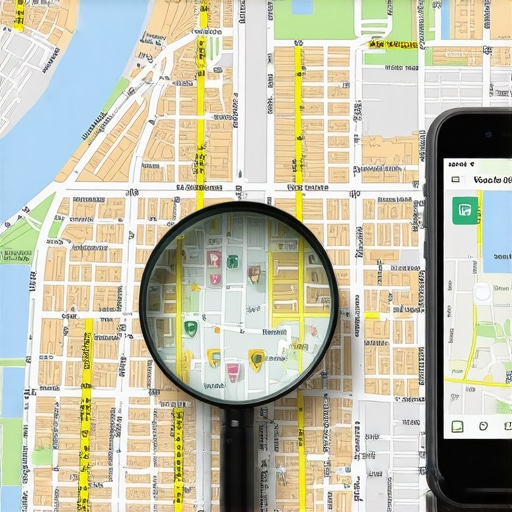
If you are serious about your google maps ranking service, you must move away from the centroid. You need to track rankings at the zip code level at a minimum, but even that is becoming outdated. In the current landscape, you need to know how you rank block-by-block. If you aren’t using a tool that provides a visual grid of your rankings, you aren’t seeing the “proximity gap” that is likely killing your lead flow. Stop celebrating city-wide wins that don’t translate into actual phone calls from the neighborhoods that matter.
Internal Link: Why Most Near Me Search Results Still Point to the Wrong Businesses
Reality Check #2: Proximity vs. Authority – The Service Area Business (SAB) Struggle
One of the most common questions I get as a consultant is: “How do I rank google business profile listings when I don’t have a physical storefront?” Service Area Businesses (SABs), like locksmiths, mobile detailers, and emergency plumbers, face a unique uphill battle. Because you have hidden your address to comply with Google’s terms of service, you are essentially fighting the algorithm with one hand tied behind your back.
To understand how to win here, you have to understand the “Core 30 Method,” a concept popularized by Caleb Ulku’s research into local search patterns. Google balances three primary pillars: Proximity, Relevance, and Prominence. For a storefront, proximity is often the “trump card.” But for an SAB, Google has to rely more heavily on Relevance and Prominence to decide where to place you. If you haven’t invested in google business profile optimization, the algorithm will default to the closest physical business every single time, regardless of how much better your service is.
Proximity remains the #1 ranking factor in the local map pack, but “Authority” (built through high-quality backlinks and a high volume of local reviews) is the only thing that allows a business to “break” the proximity filter. Think of Authority as the engine that expands your “ranking bubble.” A business with zero local authority might only rank within a 1-mile radius of its verified location. However, a business that has dominated the “Prominence” category through local sponsorships, neighborhood-specific landing pages, and a consistent flow of reviews can see its ranking bubble expand to 5, 10, or even 15 miles.
The struggle for SABs is that without a physical “pin” on the map that users can see, you have to work twice as hard to prove your local relevance. This means your website needs to be a powerhouse of local data. You can’t just list “Zip Codes Served” in your footer and expect to rank. You need unique content for those areas. You need to show Google that you are a prominent fixture in those specific communities. Without this, your zip code tracking will show a sea of red (low rankings) the moment you move away from your home office or warehouse.
Internal Link: 7 Google My Business SEO Tips for Hyper-Local 2026 Growth
Reality Check #3: The 2026 Algorithm, AI Overviews, and Zero-Click Filters
We are now in the era of the 2026 Google algorithm, where the rules of the game have shifted from “Search Engine Optimization” to “Generative Engine Optimization” (GEO). Google is no longer just a list of links; it is an AI-driven answer engine. This has introduced “AI surface citations” and “user-intent data filters” that can make or break your local visibility.
In 2026, Google uses AI to scan your reviews, your website content, and even your social media mentions to create “AI Overviews” within the map pack. If a user searches for “best emergency plumber for burst pipes in 90210,” Google isn’t just looking for the keyword “plumber.” It is looking for evidence in your customer feedback that you specifically handle *burst pipes* and that you respond *quickly* in that specific zip code. This is what we call “Human-led results.” The algorithm is prioritizing businesses that have a proven track record of solving specific problems for real people in specific locations.
Furthermore, we are seeing the rise of “Zero-Click Filters.” Google’s goal is to provide the user with everything they need – phone number, hours, pricing, and booking options – without the user ever leaving the Google Maps interface. If your profile isn’t optimized for these filters, you are invisible. According to data from Nightwatch, local tracking now requires monitoring five distinct layers: the Geo-grid, the Zip Code, the City, the Country, and the AI surface citation layer. If your local seo performance tools are only looking at the “City” layer, you are missing 80% of the picture.
The 2026 algorithm also punishes “over-optimization.” If you try to game the system by stuffing your business name with keywords or creating fake locations, the AI filters will flag you faster than ever. The key to dominating the 2026 map pack is authenticity combined with technical precision. You need to be a real business that does real work, and you need to use local seo ranking tools that can actually see through the AI layers to tell you where you truly stand in the eyes of a local user.
Internal Link: Will Your Local SEO Partner Survive 2026 Zero-Click Filters?
Actionable Strategy: How to Actually Track and Win
If you want to stop guessing and start winning, you have to move from Zip Code reports to Geo-Grids. A single zip code report gives you one data point. A 13×13 geo-grid gives you 169 data points. This visual representation allows you to see exactly where your ranking “bubble” ends. If you see that you rank #1 in the center of the grid but drop to #10 as you move east, you don’t have a “ranking problem” – you have a “proximity gap.”
Here is your 2026 checklist for local dominance:
- Audit NAP Consistency: Ensure your Name, Address, and Phone number are identical across the web. Even a minor discrepancy can confuse Google’s AI citations.
- Visualize Proximity Gaps: Use google maps lead generation tools to map out exactly where your competitors are outranking you. If there is a “dead zone” in a high-value zip code, that is where your next marketing campaign should focus.
- Build Hyperlocal Backlinks: Don’t just chase high-authority “national” links. A link from a neighborhood association, a local Little League team, or a city-specific blog is worth ten times more for your map rankings than a generic link from a PR site.
- Optimize for Intent: Update your Google Business Profile “Services” section with long-tail keywords that reflect actual customer problems (e.g., “tankless water heater repair” instead of just “plumbing”).
By focusing on these hyper-local signals, you provide the “spatial resolution” Google needs to trust your business across multiple zip codes. You aren’t just a business in a city; you are a service provider for a community. That distinction is what wins in 2026.
Internal Link: Fix Your Proximity Gap With These Near Me SEO Tactics for 2026
Conclusion: Dominating the Map Pack
Zip code tracking is a necessary starting point, but it is not the finish line. In the “brutally honest” world of local SEO, if you aren’t adapting to the realities of proximity filters and AI-driven results, you are falling behind. To truly rank higher on google maps, you need a strategy that embraces the complexity of the 2026 algorithm.
Stop settling for vanity metrics and “centroid” lies. Whether you are a solo contractor or a multi-location agency, your success depends on your ability to see the map as your customers see it. If you’re ready to stop guessing and start dominating your local market, it’s time to use a professional google maps ranking service and high-performance google business profile seo strategies that actually work.
Don’t let your competitors own the neighborhoods that should be yours. Audit your profile today, visualize your proximity gaps, and take control of your local search future. For more deep dives into the technical side of local growth, visit SEO Viper Tools.
Internal Link: Contact Us | Internal Link: Don’t Hire an SEO Agency Near Me Without This 2026 Audit